
Your Brain is Working Harder Than You Think
There's a moment every video jigsaw player knows.
You're scanning the canvas, pieces scattered everywhere, and suddenly -- there. Two pieces, maybe three, showing the same motion, the same color signature, clearly related. Quick. Quick. Before they change.
Sometimes you make it. Sometimes the video moves on and those pieces dissolve back into the chaos: all blue sky now, nothing to indicate they were ever connected. You'll have to wait for the loop, or the next coherent movement to pass that area and hope you catch it next time.
That's the thing about video jigsaws that nobody tells you upfront. The information that helps you solve the puzzle doesn't stay still. It arrives, lingers briefly, and is replace by the next frame. What you do in that window -- and what you remember after it closes -- is the real game.
What's Actually Happening
When you spot a relationship between two scattered pieces, you're doing three things at once.
Recognizing that the pieces are related. Registering where they are on the canvas. If the action is fast, the video has moved on before you can drag a piece. You have to remember the locations and snap them quickly before you forget which pieces they were.
In a static jigsaw, none of this is time-pressured. The image that made you recognize the relationship is still there when you go back for the pieces. You can take your time. The information waits.
In a video jigsaw, the information has an expiry time. The video moves on, the pieces look different, and your memory is the only thing holding the connection. You either encoded the locations well enough to find the pieces again, or you didn't.
This is a genuinely different cognitive demand. It's not harder in the way that more pieces make a static puzzle harder. It's harder in a different direction.
The Variables That Change the Pressure
Video speed. Slow footage gives you time to spot a relationship and act on it before the image changes. Fast footage decouples recognition and action entirely: you see the relationship, you note the locations, and you have to hold both in memory while continuing to play. The faster the video, the more the puzzle lives in your short-term memory rather than on the canvas.
Loop length. A short loop makes it easier: You can just stare and wait for the same opportunity to come around. Miss it on one pass, catch it on the next. Long footage with no clean loop offers no such relief. Just move on and look for the next match. Often you can "camp" staring at the approximate locations of the pieces and another frame will reveal the match again.
 Rainy Day Reading
The low-pressure end of the spectrum. The rain loops consistently, nothing moves fast enough to create panic, and the physics of the scene -- hanging lantern, falling rain, horizontal railing -- do a lot of the orientation work before the memory task even starts. A good place to start if you're new to video jigsaws. Also a good palate cleanser after something harder.
Piece count. More pieces means harder location encoding. The flash of recognition that connects two pieces is the same whether there are 30 pieces on the canvas or 300. Finding those two specific pieces afterward is not.
When the Puzzle Laughs Back
The first time you encounter genuinely fast footage at high piece count, the normal approach stops working. Matched pieces are appearing and disappearing faster than you can act on them. The canvas is chaos. The video is chaos.
The temptation is to conclude it's unsolvable and stop. The first time I tried a fast moving puzzle, I stopped and laughed at the apparent futility.
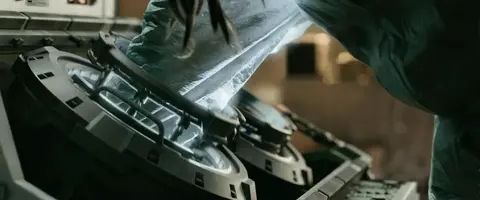 Tears of Steel - Battle Scene
Fast, chaotic, unrelenting: multiple motion directions, rapid camera pans, nothing to anchor to. The leaderboard shows it solved at 60 pieces in under 15 minutes. It has also been solved at 462 pieces in one sitting: 1 hour 22 minutes, rotation enabled. The feeling afterward was exhaustion. Not boredom. Not stiffness. Mental depletion. The 462-piece solve wasn't done to set a record. It was done to find out if it was possible. It was. Exercise makes you tired; it also makes you strong
The puzzle is not unsolvable. But solving it requires letting go of the normal approach and developing a different one.
Four Things Experienced Players Learn
1. Frustration tolerance.
This is the foundational one. A hard video puzzle can go long stretches where nothing clicks: the video is moving too fast, the canvas looks exactly as chaotic as it did twenty minutes ago, and there's no obvious sign of progress. If you quit there, the puzzle wins. If you can sit with that feeling, you eventually find the rhythm.
It's worth naming directly because it doesn't feel like a skill while you're developing it. It feels like stubbornness. It is, but it's useful stubbornness, perhaps resilience, and it transfers to other parts of life.
2. Don't panic.
Related to frustration tolerance but more immediate. A difficult puzzle at the start can feel like a maelstrom: pieces everywhere, video moving fast, no rhythm established yet. The instinct to react to that feeling -- urgency, mild panic, the sense of futility -- actively makes things worse. It narrows attention exactly when you need it broad.
Watch for motion. Watch for color. You will chip away at it.
3. Watch for motion and pattern, not content.
The instinct is to look at what pieces show: to try to understand the scene and place pieces based on recognizing content. Experienced players often do the opposite. They watch motion signatures and color patterns, sometimes snapping pieces together without consciously registering what the content is.
There's a flow state in video jigsaw solving where the analytical brain steps back and the perceptual system takes over. The motion feels right. The piece snaps. You weren't sure why until after. Chasing that state rather than fighting it is one of the things that separates good players from great ones.
4. Step back.
This is the hardest one.
Intense focus is necessary: you need it to catch the transient moments and encode the locations. But sustained hyper-focus creates a problem: the cognitive load of intense concentration actively prevents you from noticing obvious matches that a relaxed scan would catch immediately.
Watching recordings of gameplay makes this visible. You can be clearly working hard, and there, obvious to any outside observer, are two matching pieces sitting near each other that you walked right past. The focus enabling the hard work is also blocking the easy wins.
The best players alternate between states. Intense focus to catch the transient moments. Deliberate relaxation to let the obvious matches surface. Not locked into either one. The rhythm between them is where the best play happens.
This isn't unique to video jigsaws. Athletes describe it. Musicians describe it. The ability to move between focused execution and open awareness shows up in most demanding domains. Video jigsaws just happen to make it unusually easy to observe, especially when you watch your own gameplay back and see what you missed.
What This Means
Both static and video jigsaws train you. Spatial reasoning, pattern recognition, patience: those aren't unique to one format.
What video jigsaws add is a different set of demands: working memory under time pressure, frustration tolerance, perceptual pattern matching, and the ability to modulate your own cognitive state mid-solve. More cognitive systems engaged, and engaged differently.
If you want a relaxing experience, pick slow footage, short loops, and a moderate piece count. If you want a workout, pick fast footage, long loops, and a high piece count, then learn to manage the cognitive load rather than be managed by it.
The skills are learnable. The progression from "this is chaos and I quit" to "I just solved 462 pieces of a battle scene" is real. It just takes longer than most puzzles.
This is part of our series on what makes video footage work as a puzzle. See also: Directional Motion, How Your Brain's Physics Engine Helps You Solve Video Jigsaws, Color and Motion, and The Art of the Loop.