
Why Color and Motion Turn Video Jigsaws Into a Primal Experience
In a traditional jigsaw puzzle, a brightly colored subject against a plain background is a gift. A red cardinal on a snow-covered branch gives you maybe a dozen distinctive pieces in a thousand-piece puzzle. You sort them out early, place them, and move on. The color does its work once, in one place, and that's the end of it.
Video changes this completely.
In a video jigsaw, that red cardinal doesn't stay in one place. It moves. It crosses piece boundaries, appears in pieces you hadn't associated with it, and disappears again. Suddenly the color isn't a static sorting aid -- it's a moving signal, and your brain treats moving signals very differently than static ones.
What Your Eyes Were Built For
Humans are visual predators. Forward-facing eyes, high-resolution color vision, and a visual cortex that dedicates extraordinary resources to detecting and tracking movement against complex backgrounds: these are the tools of an animal that hunts by sight.
Research on human visual tracking reveals something relevant here: the brain is hardwired to resist disengaging from a moving high-contrast target. Once your visual system locks onto something bright moving against a contrasting background, attention follows it automatically, ahead of conscious decision-making. More interestingly, the brain doesn't just track where the target is. It predicts where it will be next, computing an intercept rather than simply following the path.
You do this without thinking. You've always done it.
Video jigsaws activate this system in ways static puzzles cannot. When a brightly colored subject moves through a scene, crossing from piece to piece, your visual system locks on and follows: identifying pieces you hadn't consciously selected, predicting which piece the subject will enter next, building a map of the composition through tracking rather than sorting.
It's less like solving a puzzle and more like hunting one.
Color Contrast in Motion: The Go-Kart Case
The clearest demonstration of this is high-contrast footage with a moving subject against a uniform background.
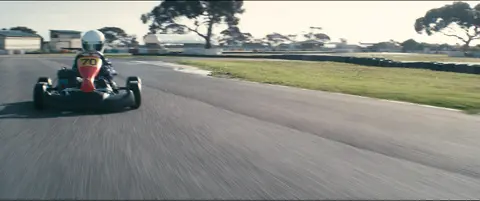 Go Kart Racer
Go Kart Racer puts a brightly colored kart against grey asphalt: about as high a contrast ratio as you can get in real-world footage. In a static image, that kart occupies one region of the frame and helps you place a handful of pieces. In the video, the kart moves through the scene, and your visual system follows it automatically across piece boundaries. You'll find yourself identifying pieces before you consciously decided to look for them. The asphalt provides a uniform grey field that makes the kart's color signal unmistakable even in peripheral vision. This is an active, demanding puzzle -- the kart moves fast -- but the tracking instinct your brain applies makes it more engaging than exhausting.
The same mechanism applies to any high-contrast moving subject: a red cable car moving through green forest and blue sky, a white seabird crossing dark water, a cyclist in bright kit against pale road. The color contrast doesn't just help you find pieces. It gives your tracking system something to lock onto.
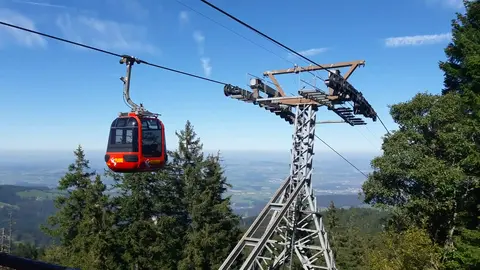 Pilatusbahn Cable Car, Alps
The Pilatusbahn cable car traverses the scene quickly, the red cabin crossing through pieces of green tree canopy and blue Alpine sky. The cable infrastructure adds geometric lines that help with structure, but the car itself is the primary tracking target: your eye finds it in peripheral pieces before you've consciously placed it. A good demonstration that the predatory tracking mechanism works just as well with a slow-moving mechanical subject as with a racing vehicle.
Color Accumulation: A Phenomenon Unique to Video
Static jigsaws can only show you the finished state of a scene. Video jigsaws can show you a scene in the process of becoming, and that distinction creates solving opportunities that have no equivalent in traditional puzzles.
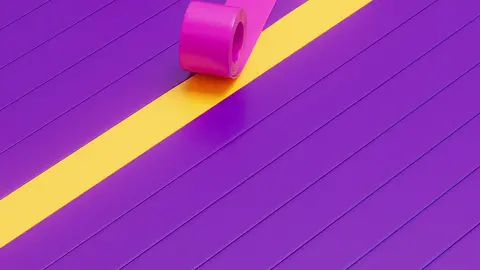 Rolling Ribbons
Rolling Ribbons starts with a purple surface and a pink ribbon rolling diagonally across it, laying down a yellow path as it goes. As the animation progresses, additional colored ribbons cross the frame, each accumulating its own colored wake in a different hue. The composition is actively changing: new color regions are being created in real time as you play. If you watch a ribbon lay down its path, you know exactly which pieces that path will eventually cross. You're not just reading the current state of the puzzle. You're predicting its future state and pre-selecting pieces accordingly. This is a uniquely video solving strategy. No static puzzle can offer it.
Color accumulation footage -- animations where color regions build over time, paint spreading, light changing, objects leaving trails or wakes -- gives you this forward-prediction capability. It rewards watching before placing.
When Color Contrast Disappears Into Itself
High color contrast is a powerful tool. But there's a point at which color complexity becomes so uniform -- where everything is saturated and vivid and moving -- that contrast as a sorting mechanism stops working. Every piece is colorful. No piece stands out.
This sounds like it should produce an unsolvable puzzle. In a static jigsaw, it might. In a video jigsaw, something different happens.
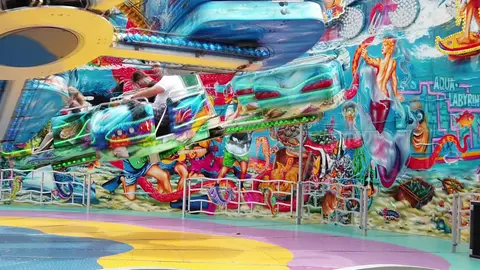 Carousel at the Fair
Carousel at the Fair is maximally colorful: vivid painted panels, spinning figures, saturated lighting, everything moving at once. Color contrast as a sorting tool is largely neutralized here because there's no plain background for any color to contrast against. What keeps it solvable -- and genuinely satisfying -- is that nothing is staying still. The carousel spins, figures move through the scene, the whole composition is in motion. Your tracking system doesn't disengage just because it can't isolate a single high-contrast target. It stays active, following multiple moving elements simultaneously. This puzzle is a challenge, but it never becomes passive. In a static jigsaw, this level of color complexity would be a slog: tedious sorting with no momentum. In the video version, the motion keeps the engagement alive throughout.
This reveals something important about what video does to color complexity. In static puzzles, high color complexity is simply difficulty: more to sort, longer to solve, no intrinsic reward for the extra work. In video puzzles, high color complexity combined with motion is engagement, because the motion continues to activate the tracking instinct that color alone would eventually exhaust.
What This Means for Footage Selection
When I'm evaluating footage for color and contrast as puzzle material, I find two questions more useful than "is this colorful?":
Is there a moving subject that contrasts clearly with its background? A high-contrast moving target gives your tracking system something to lock onto, and that instinct works faster and more reliably than conscious sorting. Bright subject, plain background, clear movement: the most reliable color-contrast formula.
Does the color change over time? Footage where color regions accumulate, shift, or develop during playback gives you a forward-prediction capability unique to video. Watch for animations, scenes with moving light, subjects leaving trails or wakes.
Footage that is uniformly complex -- everything colorful, everything moving -- can still make excellent puzzles, but they succeed because of motion engagement rather than color contrast specifically. Know which mechanism you're relying on.
This is part of our series on what makes video footage work as a puzzle. See also: Directional Motion, How Your Brain's Physics Engine Helps You Solve Video Jigsaws, Your Brain is Working Harder Than You Think, and The Art of the Loop.