
Why Directional Motion Makes a Video Jigsaw Puzzle Work
If you've ever solved a traditional jigsaw puzzle, you know the strategies: find the edges, group by color, look for distinctive shapes. Video jigsaws have all of that — and one more dimension that changes everything. The pieces move.
That movement is either your greatest ally or your greatest obstacle, depending on the footage. Understanding why comes down to a single concept: directional motion.
What Directional Motion Actually Means
Directional motion is any consistent, predictable movement across the puzzle frame — whether that's a drone camera moving over a landscape, a subject moving through a scene, or animated elements flowing in a coherent direction.
The key word is predictable. When motion has direction, your brain can anticipate where that motion continues. If you can see a a feature — a pedestrian walking, a distinctive building — moving out of the right edge of one piece, you know it enters the left edge of the piece that belongs to its right. You're not guessing. You're reasoning.
That's what separates a satisfying video jigsaw from a frustrating one. The motion becomes a solving tool.
Drone Footage: The Clearest Example
Drone footage flying over structured landscapes is some of the most reliably playable video jigsaw material that exists. The reason is simple: the camera's consistent movement direction turns everything beneath it into a navigational reference.
Roads, rooflines, field boundaries, coastlines, rows of crops -- any linear structure in the landscape becomes an axis you can use. As the drone moves, features migrate across the puzzle in a single coherent direction. If you spot a feature in one piece, you can scan adjacent pieces for where that feature continues.
 Urban Ruin
Urban Ruin is a textbook example of directional motion at work. A road runs north-south through the frame as the drone follows it, with rubble on either side. Notice how as any feature -- a crack in the road, a piece of debris -- moves across a piece and disappears at its edge, you can predict exactly which neighboring piece it enters. The rubble on either side would be nearly unsolvable in isolation. The road axis running through it gives the chaos a frame of reference. This is an approachable puzzle for that reason: the motion does genuine navigational work for you.
The same logic applies to any drone footage over structured geometry. If you've flown over streets, buildings, or shorelines, you likely already have footage that works for the same reason.
Subject Motion: When the Camera Stays Still
Directional motion doesn't require a moving camera. A subject moving through a mostly stationary frame achieves the same effect -- sometimes more elegantly.
A horse crossing a paddock. A dog running across a yard. A car moving through a street scene. In each case, the subject's movement traces a path across multiple puzzle pieces, and if you spot part of the subject in one piece, you know roughly where to look for the adjacent pieces that continue it.
For this to work, the subject needs to be large enough in frame to span multiple pieces. A distant figure that occupies a single piece gives you nothing. A subject that fills a meaningful portion of the frame and moves across several pieces gives you a trail to follow.
Scenes like this can also make a video puzzle more solvable. Imagine a traditional puzzle with large patches of blue sky where there are few color cues to work with. Now imagine this as a video puzzle where birds fly through the patch of sky. Those glimpses of birds passing from piece to piece can really open up a path to solving the puzzle, and they add a new dimension of clues to work with, especially for puzzles with short loops.
The Spectrum: Approachable to Exhausting
Directional motion isn't binary. It exists on a spectrum, and where your footage sits on that spectrum determines the difficulty and character of the solving experience.
At the approachable end: single coherent direction, consistent speed, clear structure. Drone footage over a landscape. Digital rain falling straight down -- two colors, minimal complexity, yet very playable precisely because every element moves in the same direction at the same speed. You can almost feel the physics.
At the demanding end: fast action, competing motions, rapid camera pans. This footage can make exceptional puzzles, but they are not introductory puzzles. They reward experienced players who are prepared for the challenge.
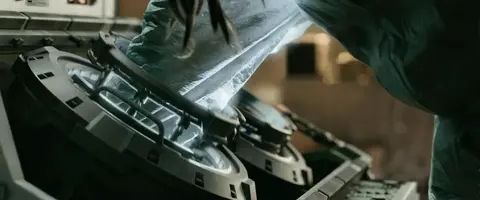 Tears of Steel - Battle Scene
This puzzle is not for the faint-hearted. The battle scene footage contains fast action, multiple competing motion directions, and rapid camera movement. There is no single axis to anchor yourself to. What makes it work is that the chaos is consistent: the energy of the scene is uniform across the frame, and once you have some experience, you can use the overall motion signature of each piece to reason about adjacency. Solve this one and you've earned it. It would be a poor choice for someone's first video jigsaw.
The takeaway for creators choosing footage: difficulty isn't a flaw. It's a variable. Know where your footage sits on the spectrum, and frame the experience accordingly.
What Happens Without Directional Motion
The absence of directional motion doesn't make a puzzle impossible. Color, contrast, and structural anchors can compensate. But footage where motion is random, uniform in all directions simultaneously, or so fast it blurs into undifferentiated color removes one of your most powerful tools.
A busy intersection where every element moves independently in a different direction can work as a puzzle, but it works despite its motion rather than because of it. You have to ignore the movement and rely almost entirely on other cues.
For creators selecting footage with puzzles in mind: if you can't predict where a motion continues from one edge of the frame, the person solving your puzzle probably can't either.
The Practical Takeaway
When you're looking at a piece of footage and asking whether it will make a good video jigsaw, watch it and ask one question: can I predict where the motion goes?
If yes -- if you can trace a movement from one region of the frame and anticipate where it continues -- you have directional motion, and you have the foundation of a playable puzzle.
If the motion is everywhere and nowhere, unpredictable and competing, you may still have a great puzzle, but it will be a demanding one. Know what you're offering.
Directional motion is not the only ingredient in a great video jigsaw. But it is the one that most reliably separates footage that plays well from footage that merely looks good.
This is part of our series on what makes video footage work as a puzzle. See also: How Your Brain's Physics Engine Helps You Solve Video Jigsaws, Color and Motion, Your Brain is Working Harder Than You Think, and The Art of the Loop.